7 Grocery Swaps That Save Money Without Making Your Food Taste Cheap
Quick Answer: The grocery swaps that save real money without hurting flavour all target the same thing - you are paying for convenience, water, or packaging rather than food. Whole chicken instead of breasts, dried beans instead of tinned, block cheese instead of shredded, and frozen instead of fresh for anything you cook all save 30-60% while tasting the same or better.
The advice to just buy cheaper ingredients is how budget cooking got its reputation. These seven do not work that way.

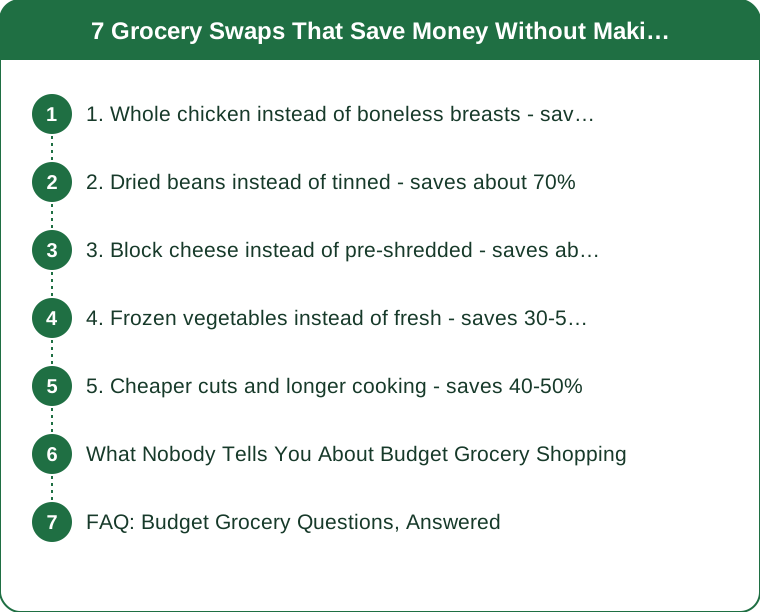
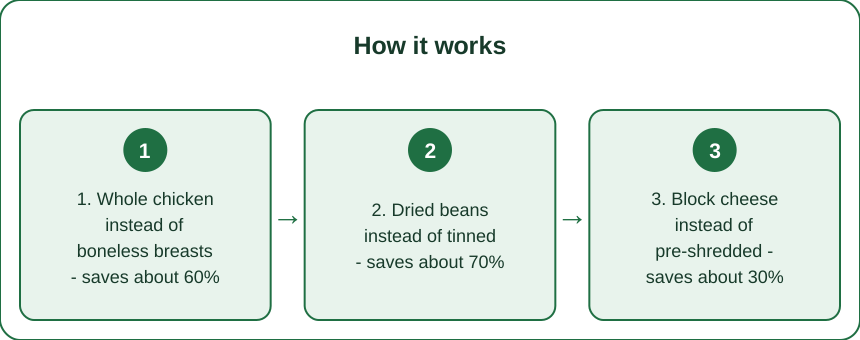
1. Whole chicken instead of boneless breasts - saves about 60%
This is the largest single saving available in most grocery baskets, and the one people resist most.
Boneless skinless breast typically runs two and a half to three times the per-pound price of a whole chicken. You are paying someone to remove bones and skin, and then you are throwing away the parts that make stock.
A four-pound whole chicken realistically yields: two breast portions, two thighs, two drumsticks, two wings, and a carcass that makes two to three quarts of stock. That is three to four meals plus a base ingredient, from one item that costs less than two packs of breast.
The objection is time, and it is fair - breaking down a chicken takes about ten minutes once you have done it twice. The shortcut if you do not want to butcher anything: roast it whole, eat the roast, then strip the carcass and simmer it. No knife skills required and you still get the stock.
Flavour note: dark meat and bone-in cooking are more forgiving than breast, not less. Breast is the hardest cut in the bird to cook well - it is a narrow window between underdone and dry, whereas thighs are nearly impossible to ruin. The cheaper option is genuinely the better-tasting one here.
2. Dried beans instead of tinned - saves about 70%
The per-serving gap here is enormous and the quality difference runs in the same direction.
A bag of dried beans costs roughly a third of the equivalent weight in tins, and tinned beans are mostly water and salt. The saving compounds because dried beans store for a year in a jar and take no fridge space.
The two real obstacles are planning and time, and both have solutions. Soak overnight, or use the quick-soak method: cover with water, boil ten minutes, cover and rest an hour. Then simmer 45-90 minutes depending on the bean. A pressure cooker or instant pot removes the problem entirely - no soak, 25-40 minutes.
Cook the whole bag at once and freeze in portions. This is the step that makes it practical. Two cups per bag, frozen flat, and you now have the convenience of tinned at the price of dried.
Where the flavour advantage comes from: you control the cooking liquid. Simmer beans with a bay leaf, half an onion, a garlic clove and a strip of kombu or a parmesan rind, and the result is meaningfully better than anything in a tin. The bean liquid itself becomes a usable stock.
Keep two or three tins for genuine emergencies. The goal is a lower average cost, not purity.
3. Block cheese instead of pre-shredded - saves about 30% and melts better
Pre-shredded cheese is coated in cellulose or potato starch to stop it clumping, which is exactly why it does not melt smoothly. You are paying more for a product that performs worse.
The maths: shredded typically runs 25-40% higher per ounce, plus you lose weight to the anti-caking coating itself.
The time cost is about ninety seconds with a box grater, or fifteen seconds in a food processor if you are doing a large amount. Grate the whole block at once, freeze what you will not use in a week - grated cheese freezes well and goes straight into cooking from frozen.
Where you will notice the difference immediately: anything that needs a smooth melt. Sauces, macaroni cheese, quesadillas, and toasted sandwiches. Starch-coated cheese produces a grainy sauce that no amount of technique fixes, which is why cheese sauce recipes so often disappoint.
Related swap in the same category: whole spices over ground ones where you use them often, and a wedge of parmesan over the pre-grated tub. Both are cases where processing costs more and delivers less.

4. Frozen vegetables instead of fresh - saves 30-50% on anything cooked
This is the swap that budget advice gets backwards. Frozen vegetables are not a downgrade for cooked applications - they are frequently nutritionally superior, because they are picked at ripeness and frozen within hours, while fresh produce loses nutrients across days of transport and storage.
The saving is real and it is bigger than the sticker price suggests, because the waste rate is near zero. Household fresh produce waste is substantial - a bag of spinach that liquefies in the drawer costs you 100% of its price. Frozen spinach costs you nothing until you use it.
Where frozen wins outright: peas, spinach, corn, green beans, broccoli for cooking, edamame, berries for smoothies and baking, and diced onion if you hate chopping.
Where fresh is still worth it: anything eaten raw - salad leaves, cucumber, tomatoes for slicing - plus roasted vegetables where you want browning, and anything where texture is the point.
The technique that fixes soggy frozen vegetables: do not boil them. Roast from frozen at high heat, or sauté in a hot dry pan first to drive off water before adding fat. Most complaints about frozen vegetables are complaints about boiling them.
5. Cheaper cuts and longer cooking - saves 40-50%
Chuck, shoulder, shin, brisket and thigh cost a fraction of steak and loin, and they taste better in every application that involves time. The connective tissue that makes them tough becomes gelatine, which is the thing that makes a braise satisfying.
The trade is money for time, and it is mostly unattended time. A pot in a low oven does not need you.
The three highest-value cheap cuts:
- Chuck or shoulder for stews, chilli, ragu, and shredded fillings
- Chicken thighs for anything a breast would do, at half the price and twice the tolerance
- Pork shoulder which is the cheapest route to a large volume of genuinely good food
The rule for all of them: low and slow, with enough liquid, and long enough that the tough stage passes. Braises pass through a phase where the meat is tougher than when it started - that is collagen contracting, not a mistake, and it resolves with another hour.
Batch this deliberately. A single large braise on Sunday becomes four different meals if you change the accompaniment - over rice, in tacos, folded into pasta, on a baked potato. Repetition fatigue comes from repeating the presentation, not the protein.
What Nobody Tells You About Budget Grocery Shopping
The unit price on the shelf label is the only number that matters, and stores make it hard to compare deliberately. Different sizes of the same product are frequently labelled in different units - per ounce here, per 100g there - which is not an accident. Do the division on your phone. It routinely reveals that the large size is worse value, which contradicts everything shoppers assume.
Waste is a bigger line item than price for most households. Cutting your waste rate meaningfully saves more than switching brands across the entire basket. The cheapest possible food is the food you already own and actually eat, which is why a Friday use-it-up meal outperforms most shopping strategies.
Store loyalty costs you. The gap between the cheapest and most expensive supermarket in the same town on an identical basket is substantial. Buying staples at a discounter and fresh items where you prefer captures most of the difference without a complicated routine.
Eye-level shelves are the most expensive shelves. Look down and look up. This is not a myth and the price gap is consistent.
The salt, acid and fat trio is what makes cheap food taste expensive. A cheap ingredient properly seasoned, finished with lemon or vinegar, and cooked with adequate fat is not identifiable as budget food. Under-seasoning is the actual thing people mean when they say budget food tastes cheap - and it costs nothing to fix.
Protein does not have to come from meat to be satisfying. Eggs, lentils, beans and tinned fish deliver protein at a fraction of the cost, and a meal built around them does not read as a compromise if it is built deliberately rather than by subtraction.
7. Buy whole spices and make your own blends - saves 50-70%
Pre-mixed spice blends are among the highest-margin items in the store, and most are dominated by cheap fillers - salt, sugar, and paprika - with the expensive components in trace quantities.
The three blends worth making yourself, because you use them constantly:
- Taco or chilli seasoning: cumin, paprika, oregano, garlic powder, chilli powder
- Italian herb mix: oregano, basil, thyme, rosemary
- Curry base: cumin, coriander, turmeric, chilli, plus whatever you like
Whole spices last two to three times longer than ground, which changes the waste maths considerably. Ground cumin is noticeably weaker after six months; whole cumin seed holds for years and takes thirty seconds to grind.
Buy spices from an international grocer rather than the supermarket spice aisle. The price difference is frequently three to five times for identical product in a larger bag. This is the single biggest per-item price gap in the entire store.
And a small one that adds up: dried herbs go into cooking early, fresh herbs go in at the end. Using them the wrong way round wastes both.
FAQ: Budget Grocery Questions, Answered
Do I need to meal plan for this to work?
A loose plan for three or four dinners beats a rigid seven-day plan, which most people abandon by Wednesday. The point is to shop against a list rather than against a mood.
Is buying in bulk always cheaper?
No. Check the unit price, and only buy bulk quantities of things that store well and that you genuinely use. Bulk purchases you throw away are the most expensive food you can buy.
Are store brands actually the same product?
Often they are made in the same facilities to a similar spec, particularly for staples like flour, tinned tomatoes, frozen vegetables and dairy. Branded advantages are real in a minority of categories - try store brand on staples first.
How much can these swaps realistically save?
Applied consistently across a normal basket, swaps of this type typically cut 20-30% off a grocery bill without changing what you eat. The chicken and bean swaps alone account for a large share of that.
What is the one swap to start with?
Whole chicken. Largest saving, best flavour outcome, and it teaches you the stock habit that quietly improves everything else you cook.
TL;DR:
- Whole chicken over breasts saves about 60% and cooks better - the single biggest win
- Dried beans over tinned saves about 70% and gives you better-tasting beans plus free stock
- Block cheese, frozen vegetables and cheap slow-cooked cuts each cut 30-50% with no flavour penalty
- Whole spices from an international grocer cost a fraction of supermarket blends
- Under-seasoning, not cheap ingredients, is what makes budget food taste cheap
None of these are about eating worse for less. They are about not paying for someone else’s knife work.
Keep Reading
This article is for general informational purposes only and is not medical advice. Always consult a qualified health professional for guidance specific to you.