7 Autumn Grocery Shifts That Quietly Cut the Weekly Bill
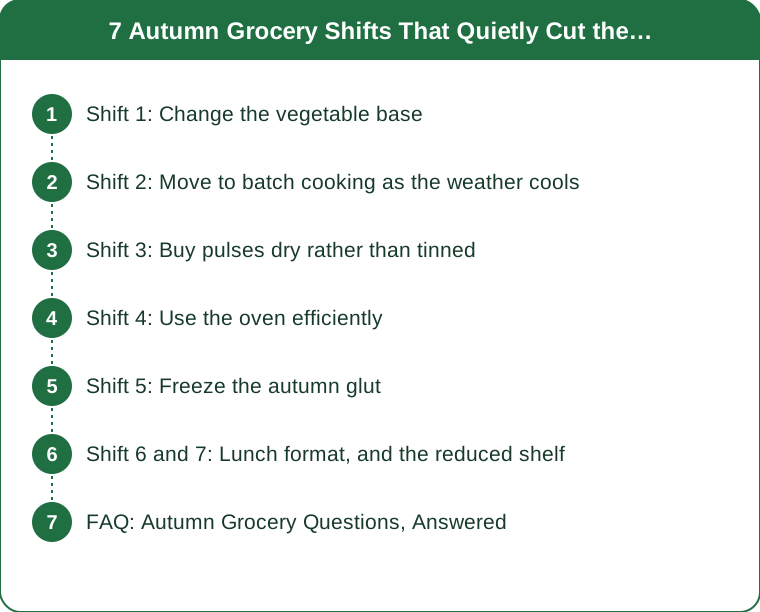
Quick Answer: Autumn changes what is cheap: root vegetables, squash, apples, pears, brassicas and dried pulses all hit their best price now, while summer salad crops become expensive imports. Seven shifts - switching the vegetable base, moving to batch cooking, buying pulses dry, using the oven efficiently, freezing the glut, changing the lunch format, and shopping the reduced shelf earlier - together cut a typical weekly bill meaningfully.
Most people keep buying the same list through the seasonal changeover, which means paying import prices for salad while the cheapest produce of the year sits next to it.
Shift 1: Change the vegetable base
What changes: salad crops - lettuce, cucumber, tomatoes, peppers - move from local seasonal production to imported or heated-greenhouse supply as autumn progresses, and the price reflects that.
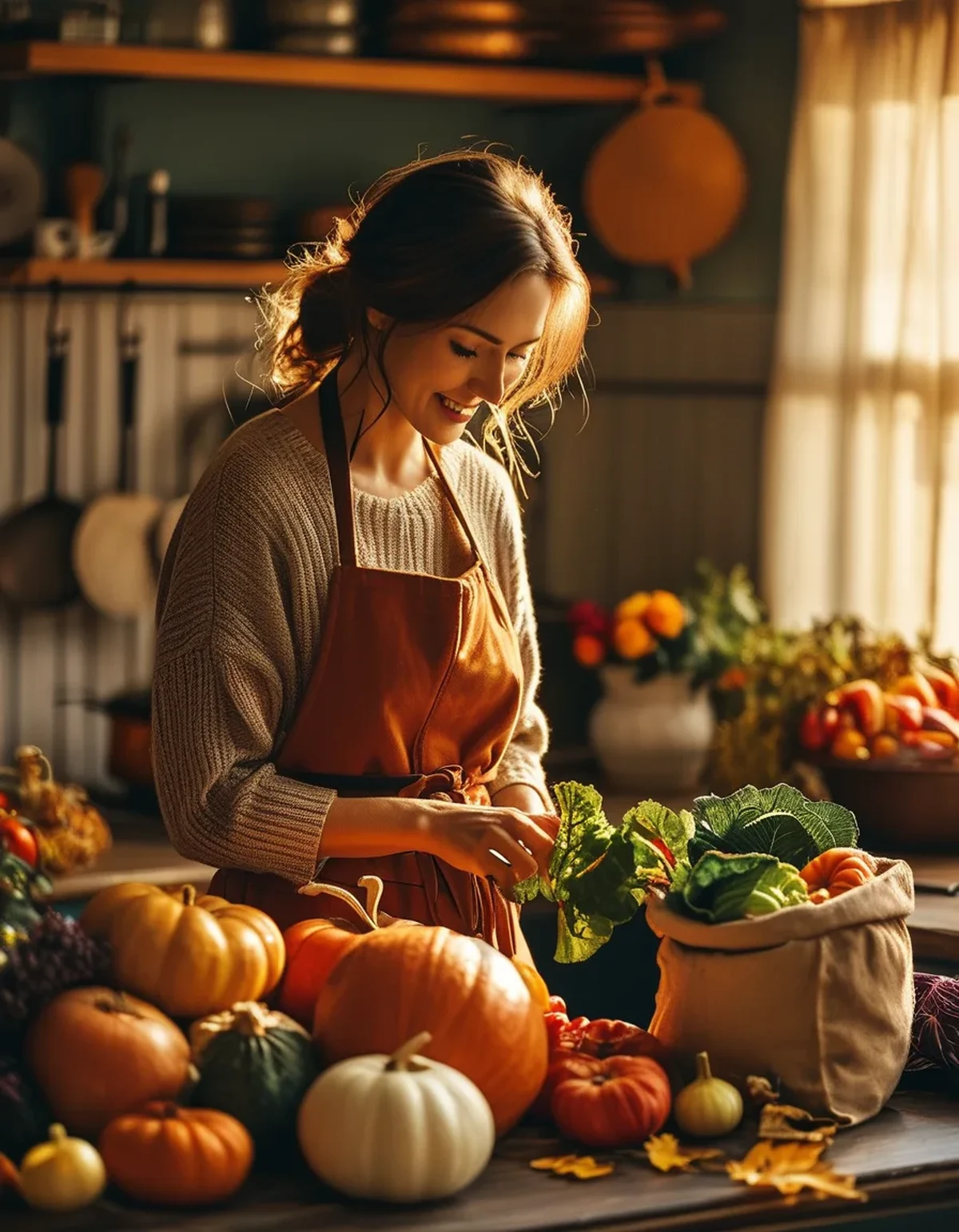
What gets cheap instead: carrots, parsnips, swede, onions, leeks, cabbage, cauliflower, squash, and potatoes. These are at their annual best for both price and quality now.
The saving: substantial, because these are among the cheapest foods available by weight at any time of year and autumn is their peak.
The practical version: replace the salad component of two or three meals a week with a roasted or braised vegetable. A tray of roasted root vegetables costs a fraction of a comparable salad and produces leftovers, which salad does not.
Squash deserves particular mention. It is cheap, keeps for weeks without refrigeration, and works in soup, roasted, in curry, or in pasta. A single large squash provides several meals’ worth of vegetable for very little.
Where to buy: market stalls and greengrocers are usually cheaper than supermarkets for root vegetables specifically, often significantly, and loose is almost always cheaper than packaged.
One thing to check: supermarket wonky or imperfect ranges are frequently the same produce at a lower price, and availability improves in autumn as the harvest comes in.
Shift 2: Move to batch cooking as the weather cools
Why autumn specifically: the food that suits cooler weather - stews, soups, curries, braises, bakes - is exactly the food that scales well and reheats well. Summer food largely does not.
Where the saving comes from: three separate places.
- Cheaper cuts become usable. Slow cooking makes the cheapest cuts of meat tender, and those cuts are dramatically cheaper per kilo than quick-cooking ones
- Less waste. A batch uses whole vegetables and whole packets rather than partial ones
- Fewer convenience purchases. Having food ready is what prevents the expensive tired-at-7pm decision
The realistic version: one cooking session weekly producing three to four portions of one thing. Not a full week of meal prep, which most people abandon within a fortnight.
What batches best: bolognese and other minced meat sauces, chilli, dal, curry, soup, and any bean-based stew. All improve after a day and all freeze well.
Equipment note: a slow cooker uses considerably less electricity than an oven for the same result, and the cheap cuts it makes usable are where the food saving comes from.
The pitfall: cooking a batch of something you get bored of by portion three. Freeze half immediately rather than committing to four consecutive days of the same meal.
Shift 3: Buy pulses dry rather than tinned
The saving is one of the largest available per unit of effort. Dried lentils, chickpeas, and beans cost a small fraction of the tinned equivalent per cooked weight.
Lentils need no soaking, cook in 20-25 minutes, and go into soups, stews, dal, and bolognese. This is the easiest starting point and requires no planning at all.
Dried beans and chickpeas need soaking, which is the barrier for most people. The practical version: soak overnight, cook a large batch, freeze in portions. One session every few weeks replaces every tin you would otherwise buy.
Why this matters beyond the direct saving: pulses are among the cheapest protein sources available, and substituting them for some of the meat in a dish reduces the most expensive component of most meals.
The practical substitution: half the mince, half red lentils in a bolognese or chilli. It is not detectable in the finished dish and it noticeably reduces the cost per portion.
Storage: dried pulses keep for a very long time in a sealed container, which makes them worth buying in larger quantities when they are cheap.
Where to buy cheapest: larger bags in world food aisles or from South Asian and Middle Eastern grocers are typically far better value than small supermarket packets - often several times better per kilo.

Shift 4: Use the oven efficiently
Why this matters more in autumn: oven use rises sharply as the weather cools, and the oven is one of the most energy-intensive appliances in most kitchens.
The principle: never run the oven for one thing. If it is on for a tray of roasted vegetables, it should also be baking potatoes for tomorrow, roasting a second tray for the freezer, or cooking something else entirely.
What to cook alongside anything:
- A second tray of vegetables for the next two days
- Whole squash or beetroot, which take a long time and keep well
- A batch of baked oats or flapjacks for breakfasts
Cheaper alternatives for single items: an air fryer, a microwave, or a hob use considerably less energy than a full oven for small quantities. For one portion, the oven is rarely the efficient choice.
The slow cooker case again: for stews and braises, it uses a fraction of the energy of an oven running for the same duration.
Batch and freeze from one oven session is where the two shifts compound. A single oven hour producing four meals’ worth of components is dramatically more efficient than four separate sessions.
One small thing: stop opening the oven door to check. Each opening drops the temperature substantially and the oven has to recover, which costs both time and energy.
Shift 5: Freeze the autumn glut
What is abundant and cheap right now: apples, pears, plums, berries at the end of their season, tomatoes at their last cheap point, courgettes, and herbs.
Why it is worth acting on: these are at their annual low price for a few weeks and then become expensive imports for the following eight months.
What freezes well with no effort:
- Berries - freeze on a tray, then bag. Straight into porridge and smoothies all winter
- Herbs - chopped, in ice cube trays with oil or water. Far better than buying a packet that half-rots each week
- Cooked apple or pear - stew with no sugar, freeze in portions, use for breakfasts and puddings
- Roasted tomatoes - roast a large tray, freeze, use as a sauce base
- Grated courgette - squeezed dry, freezes well for baking and sauces
What does not freeze well raw: most whole vegetables with high water content, and salad crops of any kind.
The freezer economics: a full freezer runs more efficiently than an empty one, so this is not a trade-off between food cost and energy cost.
Where the free version comes from: windfall apples, gluts from anyone with a garden or allotment, and end-of-market reductions. Late September is when this is most available, and asking is usually all it takes.
Shift 6 and 7: Lunch format, and the reduced shelf
Shift 6: Change the lunch format for the season.
Summer lunch is typically salad-based and assembled fresh. Autumn lunch works better as a portion of something already cooked, which is both cheaper and considerably faster.
Why this saves money: salad ingredients are expensive per portion, spoil quickly, and are frequently bought and partially wasted. A portion of soup or stew from the freezer costs a fraction and has zero waste.
The practical version: a soup or stew batch on Sunday, portioned into containers, taken through the week. A flask means it does not even need a microwave.
The bought-lunch calculation: even a modest bought lunch several times a week is one of the largest single line items in most food budgets. Replacing half of those is usually the biggest available saving in this entire article.
Shift 7: Shop the reduced shelf earlier in autumn.
Reduction timing shifts with the seasons because store closing times and stock patterns change. The main reduction round is usually a set period before closing, and in autumn many stores shift hours.
What is worth buying reduced: anything you will freeze immediately - meat, fish, bread, and prepared items. Freezing on the day of purchase means the short date is irrelevant.
What is not: fresh produce that is already past its best, and anything you do not have a plan for. Reduced food that gets thrown away is more expensive than food never bought.
The practical approach: know your local store’s reduction time, go once a week rather than daily, and go with freezer space available.
FAQ: Autumn Grocery Questions, Answered
Is seasonal produce actually cheaper?
Generally yes, and noticeably so for the categories at their peak. Autumn root vegetables, brassicas, squash and apples are among the best-value produce available at any point in the year.
Are frozen vegetables a reasonable substitute?
Yes. Frozen vegetables are typically processed shortly after harvest, are nutritionally comparable to fresh, cost less, and produce no waste. For anything going into a cooked dish they are often the better choice.
How much can these shifts actually save?
It depends entirely on the starting point. The largest single saving for most households is reducing bought lunches; the vegetable and pulse shifts are meaningful and smaller.
Is a slow cooker worth buying?
If you will use it weekly, it typically pays for itself through cheaper cuts becoming usable and lower energy use than an oven. If it will sit in a cupboard, no.
What’s the single highest-impact change?
Batch cooking one thing weekly. It reduces waste, makes cheap cuts usable, and prevents the expensive convenience decisions that happen when there is nothing ready.
TL;DR:
- Swap the salad base for root vegetables, squash and brassicas - all at their annual best price now
- Batch cook weekly; autumn food scales and reheats in a way summer food does not
- Buy pulses dry rather than tinned, and substitute half the mince with lentils
- Never run the oven for one thing, and use a slow cooker for anything braised
- Freeze the autumn glut - berries, herbs, stewed apple, roasted tomatoes
- Move lunch to a portion of something already cooked; bought lunches are usually the biggest line item
- Learn your store’s reduction time and go once a week with freezer space free
World food aisles and independent grocers are several times better value per kilo on dried pulses than supermarket packets.
Keep Reading
This article is for general informational purposes only and is not medical advice. Always consult a qualified health professional for guidance specific to you.