7 Grocery Habits That Quietly Cost You More Every Fall
Quick Answer: Seven habits do most of the damage as the seasons turn: shopping the same list year-round, buying summer produce out of season, storing autumn vegetables in the fridge, ignoring the freezer, over-buying fresh herbs, skipping the whole-chicken math, and letting the meal plan drift while the schedule fills back up. Fixing all seven takes one shopping trip’s worth of attention.
Grocery habits form in one season and then run unchanged through the rest. The list that made sense in July - salads, berries, quick cold meals - is quietly the most expensive way to shop by October.

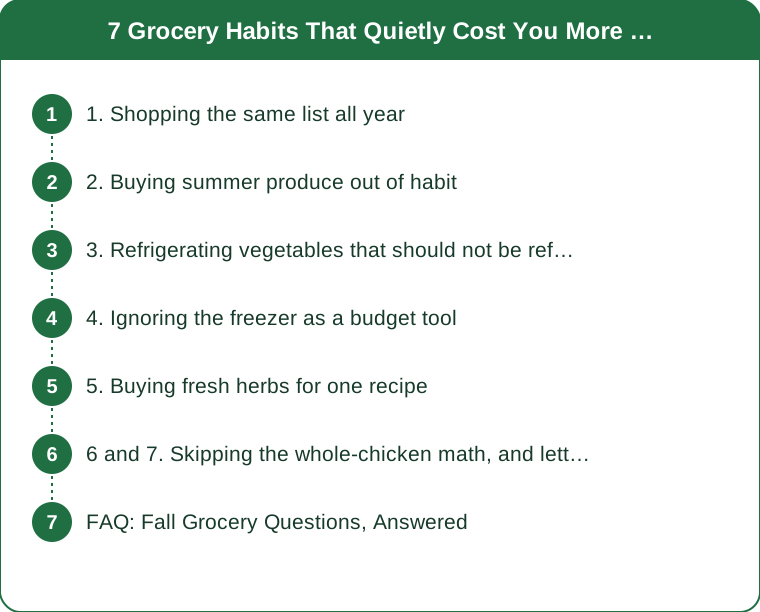
1. Shopping the same list all year
Produce prices swing enormously with season and shipping distance. Berries in July are local and abundant; berries in November have traveled a long way and cost several times as much for worse flavor.
The habit is understandable - a stable list is efficient - but it means paying peak out-of-season prices for the exact items that were the bargain three months ago.
The fix: keep a short list of seasonal swaps rather than rewriting everything. Berries become apples and pears. Tomatoes become squash and root vegetables. Zucchini becomes cabbage. Salad greens become hearty greens like kale and chard, which are cheaper in autumn and hold up far better in the fridge.
The savings here are among the largest on this list and require no change to how you cook - just to what goes in the basket.
2. Buying summer produce out of habit
Related but distinct: continuing to buy the specific items that defined summer eating even as they get worse and pricier.
Autumn tomatoes are the classic example. They cost more, taste noticeably worse, and are often bought and then not eaten because they are disappointing - which means paying a premium for waste.
The fix: for the items you genuinely want year-round, switch format. Canned tomatoes for cooking are cheaper, better, and often higher in usable lycopene than out-of-season fresh ones. Frozen berries cost a fraction of fresh in winter and are picked at ripeness. Frozen peas and corn are essentially always better value than their out-of-season fresh versions.
This is not a downgrade. For cooked applications, the preserved version is frequently the better ingredient as well as the cheaper one.
3. Refrigerating vegetables that should not be refrigerated
Autumn brings a category of produce that most people store wrong, and wrong storage is waste.
Winter squash, potatoes, onions, and garlic all want a cool, dark, dry place with air circulation - not the fridge. Refrigerating potatoes converts starch to sugar and produces an odd sweetness and poor browning. Refrigerating onions and garlic makes them soft and moldy.
Stored properly, winter squash lasts 1-3 months, potatoes several weeks to months, and onions and garlic months. Stored wrong, all of them fail in a fraction of that.
Two more storage rules that pay for themselves: keep potatoes and onions apart - onions release gases that sprout potatoes - and keep apples away from everything else, because they emit ethylene that ripens and then spoils neighbors.
The fix: a basket or paper bag in the coolest dark cupboard you have. That is the whole intervention, and it turns the cheapest produce of the season into food that lasts.

4. Ignoring the freezer as a budget tool
The freezer is the single most underused piece of cost control in most kitchens, and autumn is when it matters most because cooking shifts toward things that freeze well.
Freeze in portions, not in blocks. A large frozen mass of soup gets used once. The same soup in single portions gets used six times, and it competes directly with takeout on the nights the schedule is full.
Freeze the things that spoil first. Bread, herbs in oil, grated cheese, cooked grains, and any produce approaching the edge. Most of what gets thrown away could have been frozen a day or two earlier.
Buy meat on markdown and freeze it same day. Reduced-for-quick-sale meat is one of the largest legitimate discounts in a grocery store, and it is only a bargain if it goes into the freezer immediately.
Label with the date. Unlabeled frozen items become archaeology and then waste. Masking tape and a marker solves the whole problem.
A reasonable target: one batch-cooked freezer meal per week. Within two months there is a rotation deep enough that a busy evening never requires a decision.
5. Buying fresh herbs for one recipe
A packet of fresh herbs costs several dollars, gets used for two tablespoons, and turns to slime in the crisper within a week. Repeated weekly, it is one of the more expensive small habits in a grocery budget.
The fixes, in order of effort:
Freeze the rest immediately. Chop, pack into an ice cube tray with olive oil or water, freeze, and transfer to a bag. Frozen herbs are excellent in anything cooked and useless in salad, which covers most autumn cooking.
Use dried where dried works. For long-cooked dishes - stews, braises, sauces, roasts - dried herbs perform well and cost a fraction. Use roughly one third the amount of dried compared to fresh.
Grow the two you use most. A pot of rosemary and one of thyme on a windowsill survives with near-total neglect and eliminates the most commonly wasted purchases.
Buy the bunch, plan two uses. If you are buying fresh, decide the second recipe before you leave the store. Almost all herb waste comes from a single-use purchase.
6 and 7. Skipping the whole-chicken math, and letting the plan drift
6. Skipping the whole-chicken math
A whole chicken is usually the cheapest protein per pound in the store, and autumn is the season it actually suits - roasting is pleasant again in a way it was not in July.
The arithmetic: a whole bird typically costs meaningfully less per pound than the equivalent weight in boneless breasts, and yields two to three meals plus stock for a household of two.
A practical sequence: roast it on Sunday, use the breast meat for two meals, pull the remaining meat for a soup, grain bowl, or tacos, then simmer the carcass for stock and freeze it. That stock replaces store-bought cartons, which are one of the quieter recurring costs in a grocery budget.
The objection is time, and it is fair - but roasting is mostly unattended, and the stock can go in a slow cooker overnight with no supervision at all.
If a whole bird is genuinely not practical, bone-in thighs are the next best value and are more forgiving of overcooking than breasts.
7. Letting the meal plan drift as the schedule fills
This is the expensive one, and it is the one that arrives with the season rather than with the shopping.
Summer’s loose schedule tolerates loose planning. When the calendar fills back up, the same looseness produces unplanned shopping trips, forgotten produce, and takeout on the nights nothing is defrosted. Unplanned trips are consistently more expensive per item and generate more waste than a single planned shop.
The fix is small: plan four dinners, not seven. Seven is unrealistic and gets abandoned entirely by Wednesday, which is worse than planning nothing. Four leaves room for leftovers, one takeout night, and one improvised meal - and it survives contact with a real week.
Pair it with a standing shop day. The day matters less than the fact that it is fixed; a fixed shop is what makes a plan possible at all.
And shop the fridge first. Check what is already there before writing the list - the most common source of waste is buying a second one of something already in the drawer.
FAQ: Fall Grocery Questions, Answered
How much can seasonal swapping actually save?
It varies by region and by how much produce you buy, but out-of-season fresh produce commonly runs several times the price of in-season, and it spoils faster. For a household that buys a lot of fresh, the swap is one of the largest single levers available.
Is frozen produce as nutritious as fresh?
Generally yes, and sometimes better. Frozen produce is picked at ripeness and processed quickly, while out-of-season fresh has traveled and sat. For most nutrients the difference is small in either direction.
What is the single highest-value change on this list?
Storing autumn vegetables correctly. It costs nothing, takes one afternoon to set up, and turns the cheapest produce of the year from a one-week purchase into a two-month one.
TL;DR:
- Swap the list seasonally - berries to apples, tomatoes to squash, salad greens to hearty greens.
- Use canned and frozen for out-of-season items; they are cheaper and often better for cooking.
- Keep squash, potatoes, onions, and garlic out of the fridge, in a cool dark cupboard, and keep potatoes away from onions.
- Freeze in portions, buy whole chickens, and plan four dinners rather than seven.
None of these require cooking differently - they require the list and the cupboard to notice that the season changed. Fix the storage this weekend and the rest follows on the next shop.
Keep Reading
This article is for general informational purposes only and is not medical advice. Always consult a qualified health professional for guidance specific to you.